

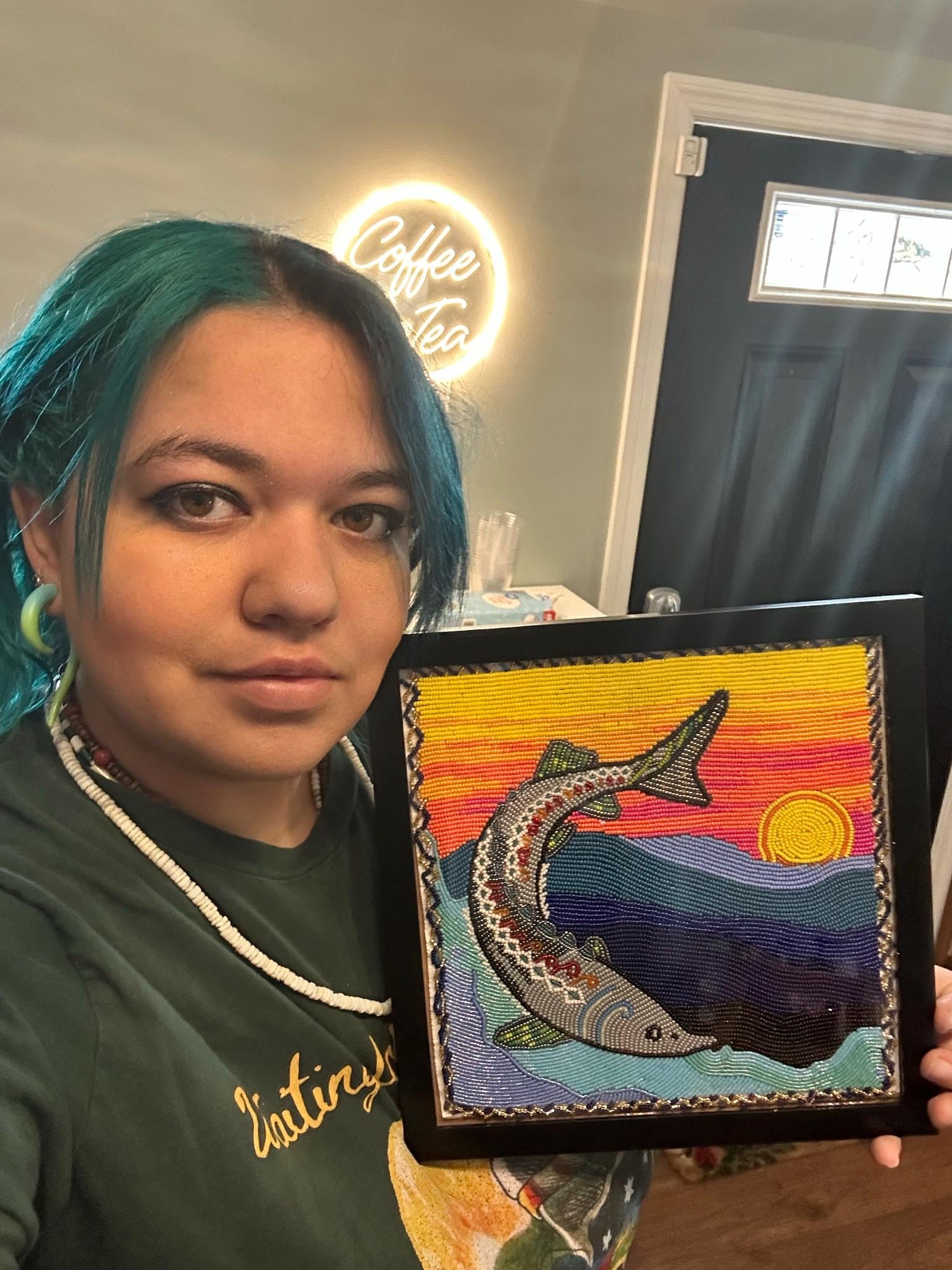
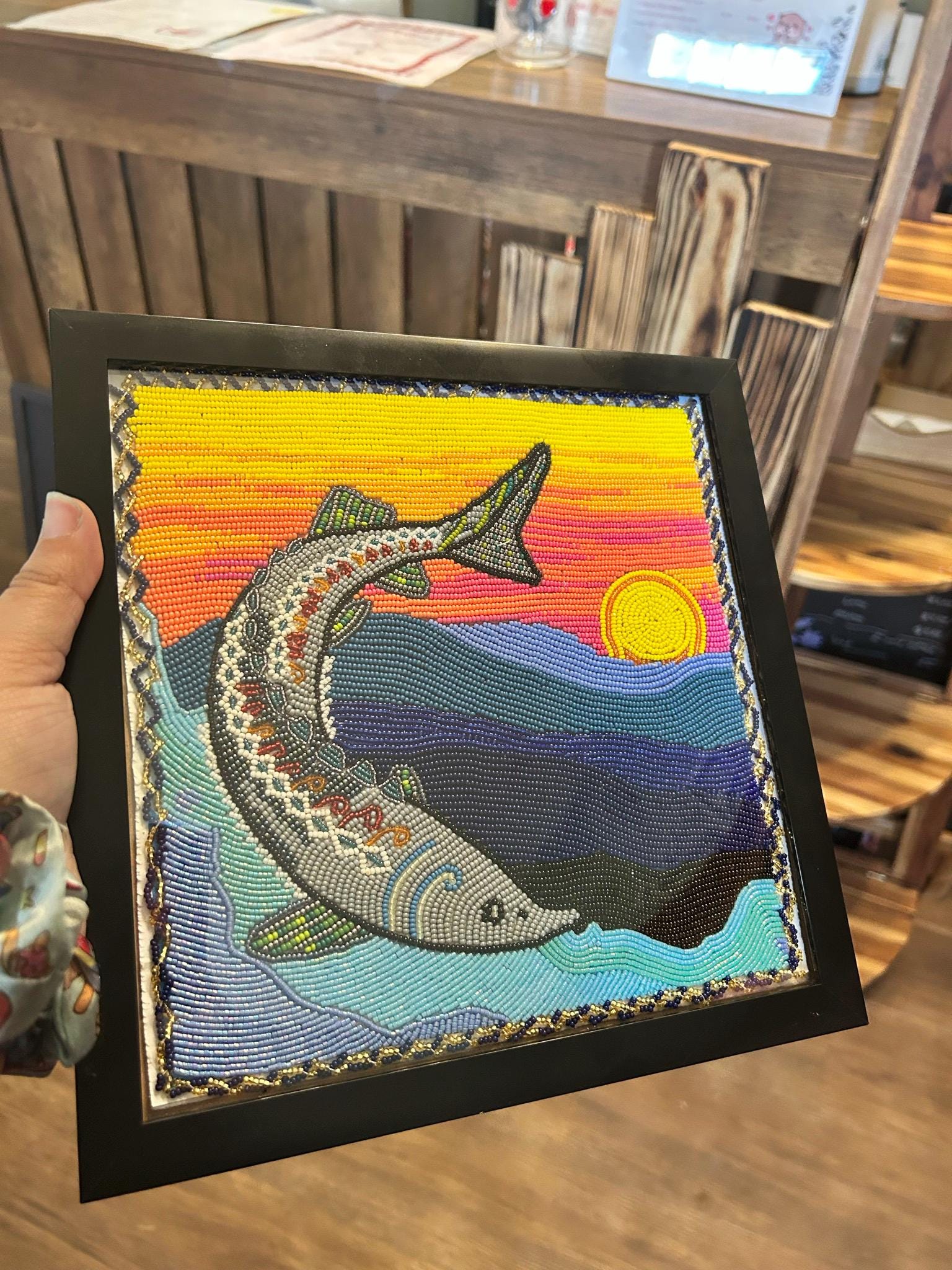
There are some works of art that are beautiful because of what we see. Others become even more powerful when we understand whose hands created them, what those hands were taught, and what the artwork carries forward. Coda Cavalier’s Beaded Sturgeon is one of those pieces. Created from an original 8-by-11-inch drawing and carefully beaded with size 11 seed beads, the sturgeon brings together Coda’s work as an artist, environmental advocate, and citizen of the Occaneechi Band of the Saponi Nation. But the story of this piece did not begin with the first bead Coda placed. It began generations earlier—and its story reaches even further back, to the rivers and fish that sustained Occaneechi people.
Beadwork Passed From Grandmother to Mother to Daughter
Coda learned beadwork from her mother. Her mother learned from her grandmother. That lineage matters. Indigenous art is sometimes presented as something belonging to the past—something encountered behind museum glass or described as a tradition that used to be practiced. But beadwork is not frozen in time. It lives because people continue to practice it, teach it, change it, and pass it to the next generation.
The knowledge in Coda’s hands today was carried through the hands of the women who came before her. Now Coda is adding her own chapter. Together, Coda and her mother own Mosnukhe Nomp, where they continue to create and share Indigenous art rooted in family, culture, and community. Coda also shares her passion for Native American beadwork and traditional arts through community workshops throughout the region. Every time that knowledge is shared, the circle grows.
The Sturgeon: A Fish Connected to Occaneechi Waters
Coda did not choose the sturgeon simply because it is a beautiful or ancient fish. The sturgeon represents a much deeper relationship between the Occaneechi people, our rivers, and the food systems that sustained our ancestors. Sturgeon were connected to the river systems of Occaneechi homelands, including the Roanoke River watershed and waters connected to the Haw River. For generations, these waterways were—and remain—more than geographical features on a map. They are living systems. The rivers provided food, transportation, gathering places, medicine, and connections between families and communities. Fish were an essential part of those relationships. The sturgeon was among the fish that helped feed and sustain Indigenous people living along these waterways. Its movement through the rivers was part of a much larger natural cycle that our ancestors understood and depended upon. Our people knew the waters. They knew when the fish moved. They knew where food could be gathered. They understood the seasons. And they understood something that modern society too often forgets: the health of the people is inseparable from the health of the water. That history gives Coda’s Beaded Sturgeon another layer of meaning.
Beading a River Relative
As a citizen of the Occaneechi Band of the Saponi Nation and an environmental advocate, Coda is beading more than the image of a fish. She is representing a river relative that connects her people to ancestral waters, traditional foodways, and generations of survival. There is something particularly powerful about the way these stories come together in this one piece. Coda was taught beadwork by her mother. Her mother was taught by her grandmother. And now Coda has taken that intergenerational artistic knowledge and used it to depict a being that helped sustain earlier generations of Indigenous people. One form of ancestral knowledge is telling the story of another. The beadwork carries the teachings of the women in Coda’s family. The sturgeon carries the story of the river. Together, they tell a larger story about relationship.
When We Protect the River, We Protect the People
The Beaded Sturgeon also carries an important message for today. Many of the rivers that sustained Indigenous communities for generations now face pressures our ancestors could never have imagined—from industrial development and pollution to habitat destruction and massive infrastructure projects. For Coda, environmental advocacy and Indigenous art do not have to exist in separate worlds. They come from the same understanding of responsibility. If a fish sustained your ancestors, what responsibility do you have to that fish? If a river fed your people, what responsibility do you have to that river? If those waters helped make it possible for generations of your family to exist, what responsibility do you carry to ensure those waters remain for generations who have not yet been born?
The answers are embedded in relationship.
When we protect the river, we protect the fish.
When we protect the fish, we protect the foodways.
When we protect the foodways, we protect culture.
And when we protect culture, we protect the memory and relationships that have sustained our people for generations.
This is why the sturgeon is more than the subject of Coda’s artwork. It is part of a larger story about reciprocity. The river sustained the people. Now we have a responsibility to sustain the river.
Thousands of Small Beads Creating Something Whole
Size 11 seed beads are tiny. Working with them requires patience, precision, and an ability to see what something will become long before the finished image appears. One bead by itself may seem insignificant. Then another is added. And another. And another. Slowly, color becomes a pattern. A pattern becomes a form. And the form becomes a sturgeon. There is something fitting about that process. Community works the same way. So does environmental advocacy. So does cultural preservation. One person teaches another. One mother teaches her daughter. One family protects a tradition. One young person learns. One community stands up for a river. One voice joins another. Eventually, what appeared small becomes something powerful.
A Living Indigenous Art
It is important to understand Coda’s work as both traditional and contemporary. She is carrying forward knowledge taught within her family while creating artwork that reflects the world she lives in now. That is what living culture does. It grows. It responds. It remembers. And it creates. Coda’s artwork has reached audiences beyond her immediate community, including through North Carolina exhibitions such as Stories Told by Breath at the Gregg Museum of Art & Design in Raleigh. Yet some of the most important work happens much closer to home—when traditional arts are practiced within families and shared within communities. Cultural continuation does not happen automatically. Someone has to decide to teach. Someone has to decide to learn. And someone has to decide that what was handed to them is worth carrying forward.
A North Carolina Story
The Beaded Sturgeon is also a North Carolina story. Coda is a citizen of the Occaneechi Band of the Saponi Nation from Alamance County, and her artwork emerges from a living Indigenous community whose relationship with these lands and waters did not disappear. Native people are still here. Native artists are still creating. Native families are still passing knowledge between generations. Native people are still protecting the rivers that sustained their ancestors. And young Indigenous artists like Coda are finding their own ways to carry those teachings forward.
The piece may measure only 8 by 11 inches, but what it contains cannot be measured so easily. It carries a grandmother’s teachings. A mother’s hands. A daughter’s creativity. A Native Nation. A fish that helped sustain a people. A river that carried life. An artist’s responsibility to the natural world. And a tradition that continues because another generation chose to pick it up and carry it forward.
From grandmother, to mother, to daughter.
From river, to fish, to people.
From drawing, to bead, to story.
The sturgeon sustained our ancestors. The rivers sustained our communities. And today, through Coda’s hands, that relationship is being remembered, honored, and carried forward for another generation.